Monday, 3 October 2011

Amazon's Kindle Fire. Is it Worth $199?


Kindle Fire
It's official.  Amazon has a few new Kindles, and one is the color Android-based Kindle Fire. The press was stunned when the Fire's $199 price was announced.  The hardware specs are competitive but missing a few standard components.  Some estimate 5 million or so will be sold before the end of this year. The Fire isn't the first 7" tablet out there, and it isn't even the cheapest one. Walmart.com has a half dozen 7" tablets available for under $200. You can buy the Maylong 7" tablet for as little as $97.

Here are a few:
So what magic makes the press think Amazon's Fire will sell better than any of these?  Sure, most of these have worse specs than the Fire.  Yet many also have hardware features (Cameras, HDMI-out) the Fire doesn't include. All have WiFi.  All are touchscreen Android tablets.  All run apps including all of Amazon's apps. Lined up spec for spec the Fire doesn't glow for what it can do.  It blushes for what it doesn't do.

So what is the secret?   I'm blaming it on Respect.  Amazon, like Apple, has built up a reputation for treating customers well. They have both simplified the process of buying media and products from them. We respect Apple and we respect Amazon. They are both American originals. We surrender our beliefs to Apple in exchange for designful and productive devices we didn't know we needed. The press and Amazon fans have done the same concerning the Fire. I've pre-ordered mine out of the same respect.

Let's do a reality check though.   The Fire is a first generation device.  Remember the first wedge Kindle?   Original, but far from evolved. The second and later generations were better in every way.  My experience repeatedly demonstrates that 1st generation devices are poor investments. This is more often true for ground-breakers, and Amazon is a ground-breaker. Late comers/Followers can learn from the mistakes made by others.  I expect the second generation Fire to be thinner, faster, and have a few more features than this first gen Fire.  It may also be less expensive.  Previous Kindles have gotten cheaper each year since the first one came out at around $400.

So is the Kindle Fire a good investment?  I'm going to rate it a tentative "yes". From what I can tell the hardware is similar to the Blackberry Playbook. Made by the same manufacturer I'm expecting the Fire to be similarly well-made. The dimensions are a little different, but the details are very similar.  Each specification the Fire lists is equal to or better than the competition. A 1024 x 600 screen when many have 800 x 480 screens. Capacitive multi-touch when many have resistive single-touch input. A dual core processor when many have single core chips.  The Fire will have a liquid user interface (UI) and shouldn't stutter or pixelate displaying movies or photos. The screen will react instantly to your touch, and using it should become a mere extension of your thoughts.   I expect Amazon to do it right.  The Fire should delight the user. Should it not you can certainly expect the 2nd generation to.

Yes,  I believe the new Kindle Fire is worth $199.   The Blackberry Playbook and HTC Flyer are more capable tablets, and at $299 they are also priced proportionally correct given their additional features.  If you think you might want a Fire, don't wait. Reviews will be out before new orders are shipped and you can always cancel should you change your mind.

Comments are welcome.  Feel free to contribute.
4D


P.S.: If you enjoy my blog, please consider clicking on an Ad or two.  Thanks!
READ MORE - Amazon's Kindle Fire. Is it Worth $199?

Sunday, 2 October 2011

BlackBerry Playbook Review. Finally a Realistic Price!

BlackBerry PlayBook
With most 10" tablets hovering around the $500 price point it never made sense to me why the major vendors thought they could ask the same for their 7" tablets.  HTC's 7" Flyer is $499. (edit: Oct 1st BestBuy lowered the price of the HTC Flyer to $299).  RIM's BlackBerry PlayBook was $499 until a few days ago when they dropped the price to $299.  The PlayBook finally offers a compelling set of specs and an innovative OS/UI at what is now a reasonable price.
Headphone Jack, Volume and Play, and Power.  Rear Camera on Back.
Hardware:
 - Dimensions: 7.6" x 5.1" x .4" thick. Weighs 0.9 lbs/425g.
 - Cameras: 3mp front.  5mp rear.
 - Touch-Sensitive bezel.
 - Bluetooth DUN, HID, SPP.  A Bluetooth mouse worked, but I failed with Bluetooth keyboards.
 - WiFi 802.11 b/g/n
 - Front-facing Stereo Speakers
 - Two Microphones. Voice Notes sound excellent.
 - Notification LED
 - External Volume rocker
 - External Play/Pause button.
 - Headphone jack.
 - Mini HDMI port.  Full mirroring of the UI on your HDTV.
 - Micro USB port.
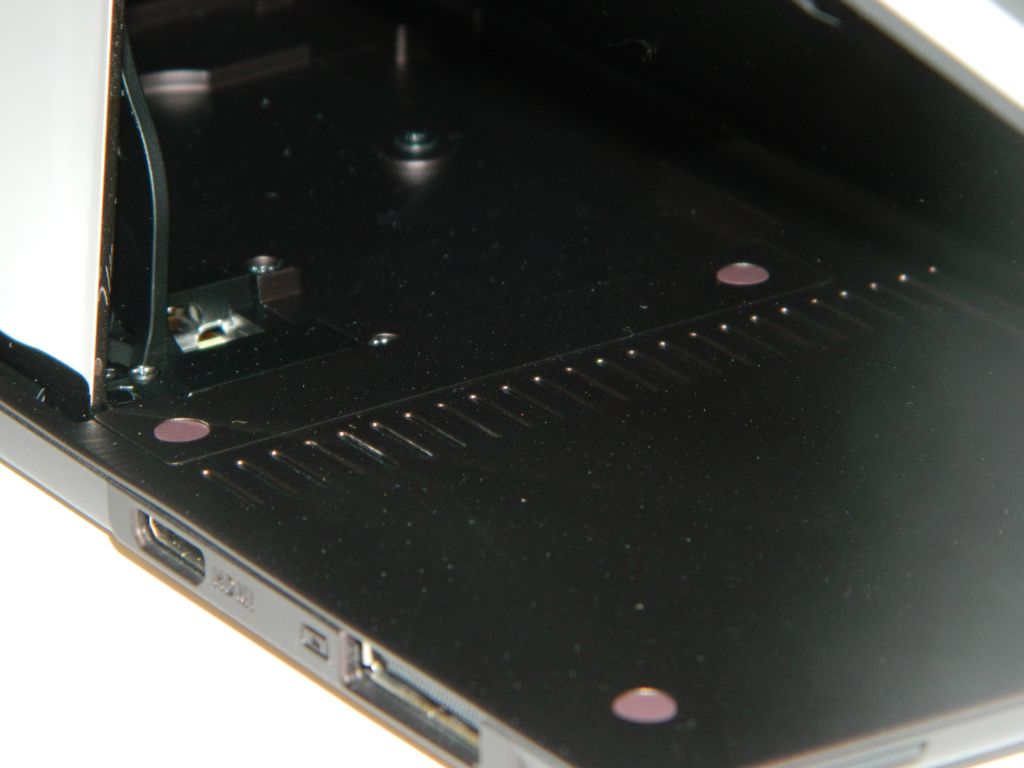
Bottom Edge: microHDMI, microUSB, and Dock Port. 
With more features than the upcoming Kindle Fire, the $299 price may be right on track to help RIM sell a few million more of these.  They'll still need more apps in their apps store. Adding the ability to run Android apps will be a step in the right direction even if there are limits on what apps will run.  Updating the Playbook with Email, Contacts, and Calendar app will also go a long way to bring this tablet into the mainstream.

The Playbook is well built and comfortable to hold. It doesn't feel flimsy or squeaky, and the matte-finish rear is both fingerprint-shy and non-slippery.   Tapping on the back only finds a small hollow right in the middle where the logo is, with the rest of the area sounding solid.  I greatly appreciate the play/pause button between the volume + and - buttons on the top edge. The front facing speakers are loud and efficient. The included soft slip-on cover was a nice touch too.

Cons:  No dedicated email app.  No dedicated contacts app. Limited app store compared to Android. The power button is also hard to press when you want to turn the Playbook ON.  Very slow to boot up from the OFF state.
Music App
Media:  Codec support is decent.   AVI, WMV, and MP4 videos play just fine with the stock Video app.  An MKV sample I had would not play.   MP3s, WMAs (+ WMA lossless), AAC and M4A audio files would play.  FLAC files wouldn't.  The Music app allows sorting by Songs, Artists, Albums, and Genres. You can shuffle or play sequentially though a list. There is an on-screen volume slider, progress bar, and full play controls within the app. You also have a dynamic Search function. No Bookmark or Playlist options I could find though.  The video app takes advantage of the Touchscreen capabilities and lets you stretch your video with two-fingers to enlarge or shrink them, as well as pan around the moving video as if it was just a photo. No bookmarking in the video app either, and it won't remember where you left off when you return to a video either.
Video Scene
UI:  I'll give RIM some credit here.  The Playbook's User Interface is original, practical, easy to understand, and fascinating to use.  Far more clever than any iOS or Android device has implemented to date.  I have to believe it was only the high price and missing apps that kept the Playbook from catching on faster.  The price has been corrected now.  Hopefully an Apps update will show up soon.
Multi-Tasking


Summary:  This is a very capable tablet. The $299 price is fair for what you get and what it can do.  Screen reaction is fluid. Media playback is beautiful though not fully-featured. The OS is refreshing compared to Android and iOS, but the missing email app and android app support is a wound that needs repair before I'll recommend this to anyone. Are you listening, RIM?    I'm parking mine until that update shows up. The HTC Flyer is also $299 now, and it's an Android 7" tablet with some useful enhancements.

4D


P.S.  I you enjoy reading my reviews, please consider clicking on an Ad or two.   Thanks!
READ MORE - BlackBerry Playbook Review. Finally a Realistic Price!

Wednesday, 28 September 2011

Asus Slider Review. Clever, but Practical?

My Slider arrived via UPS on 9/29/2011. I bought it from CircuitCity.com as they had it in stock ready for shipping. The box was typical Asus with the tablet in a plastic tray and included accessories stored beneath it. All the glossy surfaces had clear plastic to protect them that you'll get to peel off.  It came with an AC/USB Power Supply, USB cable, warranty card and a User's Manual. "Inspiring Innovation Persistent Perfection" printed on the last two to put you in a good mood.
The Slider came with Android 3.1 installed, but started downloading the 3.2 update as soon as I had it connected to my wifi router. 20 minutes later or so 3.2 was installed. Out of the box and unpeeled the Slider is a thing of beauty. The front, of course, is mostly a big piece of glass. The setting for this glass is a wide bezel that bows out on the ends with a brushed metal edging on the sides and top. A spin around the edge discovers the power button, volume rocker, and microSD slot on the left end.  Asus's docking port and a mini-HDMI port are along the top. The headphone jack and USB port are nicely articulated on the right end. 
That metal edging wraps around to the back where it widens to a 1.375" band across the bottom. A chrome strip seperates the brushed metal from a bronze field with the camera lens centered near the top. The top center edge has a raised lip at the seam between the front and back, with an arrow hinting something will happen if you pull here. Indeed, with a slight lift the front half rotates up to park itself above the newly exposed keyboard. The screen comes on and confronts you.  The screen's resting angle is roughly 38 degrees above horizontal and not further adjustable.
The keyboard keys are smaller than usual, but have a good action and nice feel to them in action. There are a few android-specific keys.  They have included the number keys along the top row. The One and Six have a bright circle around them to provide a visual location aid.  It appears as if it is carved from a bronze ingot, but is likely a high density plastic.  Not the best keyboard for android tablet use, but it is certainly handy.  Folding under the screen as it does leaves the screen exposed.  I'll definitely need a case for this tablet.

Dimensions: 10.75 x 7.1 x .72 inches. 2.21 lbs.  Not light. Not thin.

Hardware:
 - Screen: 10.1" IPS, 10 point multitouch, 1280 x 800, Gorilla Glass Screen.
 - Processor: NVIDIA Tegra 2 dual core mobile processor 1Ghz.
 - Battery: 25W/h Li-Polymer.  Estimated 8hrs between charges.
 - Cameras: 1.2MP front.  5MP rear
 - WLAN: 802.11 b/g/n@2.4GHz
 - Bluetooth: V2.1+EDR
 - Memory: 1GB,
 - Storage: 16GB/32GB + MicroSD card reader (up to 32GB).  12.63GB available when new.
 - Ports: mini-HDMI port, Full size USB 2.0.
 - Single (mono) speaker.
 - Microphone.
 - G-Sensor
 - Light Sensor
 - Gyroscope
 - E-Compass
 - GPS

 - Volume +/- rocker
 - Headphone/Mic jack.
 - Keyboard: Android-specific keys include Home, Back, Search, and Menu.  You also have Brightness up/down, and Wifi & Bluetooth toggles.

Build Quality: Impressive. When folded the top and bottom are a graceful compliment to each other. The front edge chamfers down then tapers to round over the back edge.  The body is a composite of brushed metal, bronze (paint), and a little chrome. Cable connections are nicely articulated from the bottom edge. Buttons are inset yet project just enough to exhibit their function and permit their use. Reset is a button rather than a hole on this tablet. Speakers are a bit muffled when the tablet is closed, but perk up when you lift the screen to reveal two columns of slots as speaker grills. Strong magnets hold the screen down and up.  The user manual warns against leaving your credit cards too close to the Slider.   The lift mechanism is an offset parallelogram.  The exposed face of this brace is a mirror polished rectangle with "ASUS" etched into it. The IPS screen is easy to see from any practical angle.

Media capabilities: AAC, MP3, MIDI, OGG, and WAV music codecs are all listed as supported in the User's Manual. I was also able to play WMA and WMA lossless files, along with FLAC files with no problem straight from the file browser and in the Music app.  H.263/H.264 MPEG4 is the only video codec listed as supported. I was able to play MP4 videos with no trouble.  AVIs played but with pixilation. MWV movies wouldn't open. There are apps available in the Market that will play just about any video though so don't let the limited initial video support disturb you.
Audio output from what sounds like a mono speaker source is limited to middle and upper frequencies. Audio levels only dropped a little with the keyboard closed tablet down. Quality out the headphone jack to good headphones is a pleasure though.  Their "Supreme SRS Sound with max bass response" is a step or two better than the typical android tablet sound quality with no enhancements. I'll warn you to turn the sound down if you've been listening to the onboard speaker when you switch to headphone or you're in for an ear-busting surprise. This tablet can easily get loud enough to drive the most demanding headphones I have.

Asus applications:  ASUS Launcher, MyLibrary, MyNet, MyCloud, ASUS Sync, Asus @Vibe
Other Include Apps: File manager,  Kindle books, Zinio Magazine, PressReader, Polaris Office
Google Apps: GMail, Google Maps, Google Places, Google Navigate, Google Latitude, Android Market, Google Music, Google Videos, Google Books, ...

In use it is a heavy tablet but as capable as any of the competitors out there. Unless you'll always have a horizontal surface to open the keyboard up on, the extra weight is a bit of a penalty to have to carry. Yet if you plan to use the Slider as a laptop/notebook replacement it may be the perfect solution. The included Polaris Office app (word/spreadsheet/presentation) and that keyboard will let you get some serious work done. When folded away you have tablet simplicity behind a beautiful touchscreen to entertain yourself with.  This tablet also has bluetooth and a USB port on the side.  It is easy to add a full-sized keyboard and mouse if you really want to get serious. HDMI-out lets you mirror the android UI onto any HDTV or computer monitor with an HDMI port.  Don't buy it if you only want to check email and play a game of Angry Birds.  Consider it if you were considering a netbook to shrink your travel load.  This has a nicer screen and broader array of uses than any netbook, and you can still get your work done on it for half the carry-on weight. It'll fit perfectly on that seat-back table too.
Conclusions?  I've spent the last few days with my Slider.  It is easier to lug around than my Asus Transformer and it's keyboard dock. Far easier to tote than my notebook PC. It connected quickly and reliably to my home and work WiFi networks. It allowed me to check and reply to my email. I could browse the web when I needed to. I passed the boring moments playing Soduko or Angry Birds on it. That clever keyboard let me work on this review with relative ease.  The screen is great.  The Build is great.  The engineering is clever.  With nothing bad to say and only  the size and weight to pick on I have to give the Asus EEE Slider an A+ Great Buy. It's unique features require a unique user though.  If you fit that description then this is the tablet for you. Don't buy it if you want thin and light.

4D


PS:  If you enjoy my reviews, please consider clicking on an Ad or two.  Thanks!
READ MORE - Asus Slider Review. Clever, but Practical?

Friday, 23 September 2011

Cradle for Sony Tablet S. My Review.

Sony's S Tablet includes the Chumby app, an alarm clock app,  as well as a great TruBlack screen for movie and photo viewing. When you put your tablet on the dock it pops up the choice of Desk Clock, Chumby app, or Gallery.  Laying flat on a table isn't the best position for taking advantage of these features, so Sony has now released a dock to hold the S upright and charge it at the same time. My dock arrived the Sept. 20.  I've had a chance to use it a few days now. 
Desk Clock/Alarm
It doesn't come with an AC adapter of its own. You have to commit the one that came with your tablet or purchase a spare from Sony.  A shame, really, as I had intended to keep the dock at home and take my charger to work so I could top my S off when I wasn't using it.
high angle
low angle


The dock also allows two slightly different support angles. One best for passive viewing functions and the second a better angle if you'll need to tap on the screen repeatedly. Made of a stiff plastic and all black except for the rear support, it does a fine job of holding up the tablet in landscape with the thin edge down. The tablet's charge port aligns with the connection on the dock. You plug your adapter into the bottom. There is no way to use this cradle with the tablet in portait (vertical) mode.  There are no other ports or outputs.
Bottom cable jack.
For $39 this cradle/dock is a useful accessory and fairly priced compared to docks I have purchased for other tablets. I wish it had been more capable (HDMI-out perhaps?) and had come with its own power supply. If you need a cradle for the Sony Tablet S though this is your only choice at the moment, and it is considerably better than a picture stand.
My recommendation?  If you need it get it. It works as advertised. Best recommended for your bedside table.  A great alternative and improvement over the standard alarm clock.

4D


P.S. : If you enjoy my reviews, please consider clicking on an Ad or two.  Thanks!
READ MORE - Cradle for Sony Tablet S. My Review.

Tuesday, 7 June 2011

Asus Transformer Keyboard Dock. With Photos.


One of the nicest features of ASUS' Eee Pad Transformer  is the Keyboard/Docking Station.  For $150 (MSRP) you get a nice keyboard, two full sized USB ports, a full sized SD-HC slot, a second battery for your tablet, and a trackpad.  The dock is as well made as the tablet.  When connected you have a nice touchscreen netbook that shuts off when folded closed. The hinge is stiff enough to hold the tablet at any angle, with the weight of the battery in the dock keeping it from tipping backwards.
Together they make a perfect pair.
Good friction in the tablet hinge.
Top row includes Android, media, and utility keys.
Special top row keys include (left to right)
  • Back
  • WiFi
  • Bluetooth
  • Trackpad on/off
  • Backlight dim
  • Backlight bright
  • Backlight Auto
  • Screenshot capture
  • Web Browser
  • Settings
  • Previous Track
  • Play/Pause
  • Next Track
  • Mute/Unmute
  • Volume down
  • Volume up
  • Lock/Unlock (sleep/wakeup if no lock is set)
Left side features cable jack, reset, and USB port (under flap)
When docked, the tablet's charger and cable connect to the dock instead.  It will charge both the dock's battery and the tablet when connected.  Also notice the slight lift of the keyboard's back edge by the tablet bracket when rotated up.
The right side features an SD-HC slot and another USB port (under flap).
One of the nicest features the Dock brings to the tablet it the SD slot.  It reads cards up to 32gb, and is the perfect way to import photos from your digital camera. Simply take the card from your camera and slide it into the side of the keyboard.  A notification will show up on the tablet which you can tap on to bring up options to display the card content (folders and files) or eject it safely. You also have two USB ports for accessories or external storage. Android 3.1 supports an array of keyboards, mice and game controllers.  That should make the ASUS Eee Transformer the best device for Android game players out there.

Conclusion:  If you own the Transformer, you need this keyboard/dock. Well built.  Feature rich. A great value. Be warned though, as any price over $150 is from a scalper. Demand is high for this dock, and people are taking advantage by buying them up at MSRP and reselling them for more. Mine came from Newegg.com

4D.

PS:  If you enjoy my blog, please consider clicking on an Ad.  Thanks!
READ MORE - Asus Transformer Keyboard Dock. With Photos.